Your pet is part of your family – and, naturally, sometimes part of your travel plans too. On Austrian flights, you can take your cat or dog with you under certain conditions.
Whether your pet travels with you in the cabin or in the cargo hold depends, among other things, on its size and weight, as well as the regulations of your destination country. Here you will find all the important information, requirements and tips to help you prepare for your journey together.
Important information
- You can bring up to two healthy pets in an approved carrying container.
- Your pet must be at least twelve weeks old. Young animals must already be weaned.
- We do not accept pregnant animals.
- Your pet may be carried in the cabin or cargo hold depending on their size, weight (including carrying container) and the relevant regulations of the destination country. You will find further details below.
- Special conditions apply to travelling with assistance dogs (e.g. guide dogs or hearing dogs).
It is not possible to carry large animals in the cargo hold to certain destinations due to local conditions and restrictions.
Please note that cats and dogs belonging to snub-nosed (brachycephalic) breeds are not permitted in the hold as they are particularly sensitive to temperature and stress.
Please notify us in good time if you wish to bring your pet with you. You can make bookings for travelling with your pet in the cabin yourself via My Bookings (except for flights to the USA) or, for example in the case of larger animals, via the Service Centre. We will check availability and whether all requirements for transporting your pet are met.
Small pets in the cabin
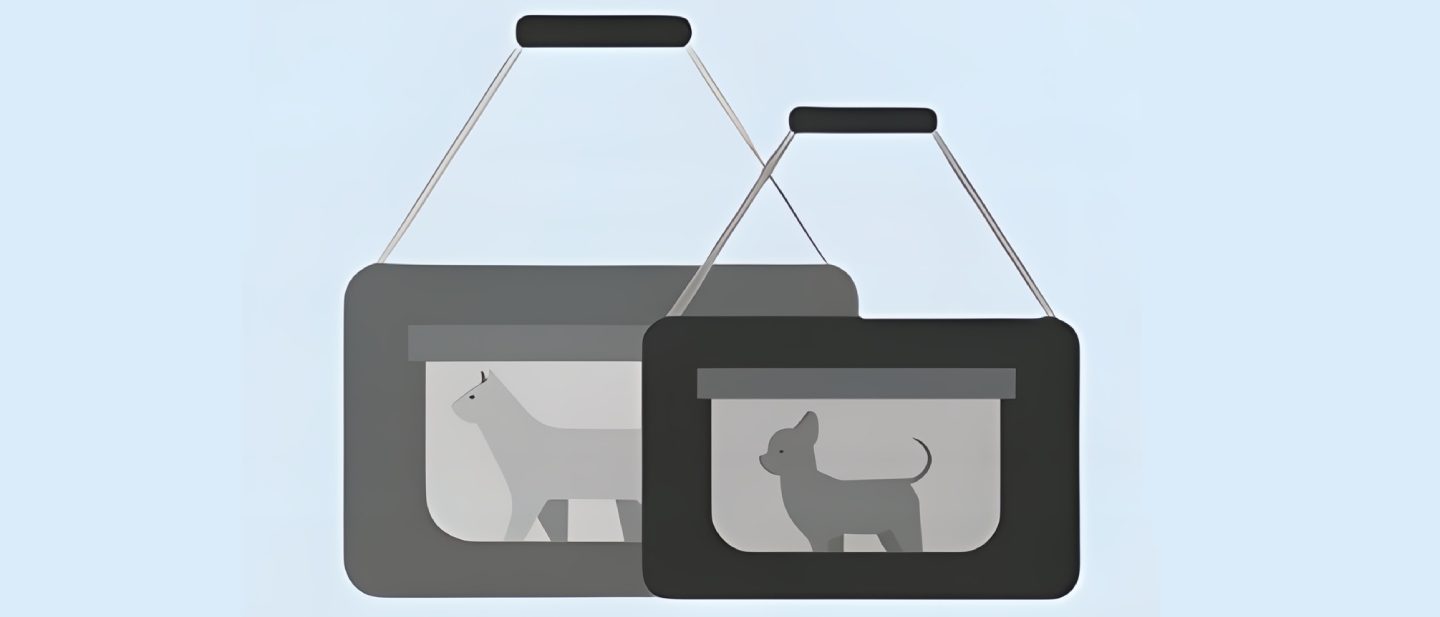
The carrying container must:
- be soft, bite-proof and leak-proof;
- be insulated against odours;
- be adequately ventilated, even when closed; and
- be large enough for the pet to stand, turn around and lie down normally.
The total weight of the animal and the carrying container must not exceed 8 kg. The carrying container must not exceed the dimensions of 118 cm (55 x 40 x 23 cm) so that it can be stowed under the seat in front. It should therefore not have a solid frame, wheels or a telescopic handle.
Please note: in some countries, such as the United Kingdom and South Africa, animals must be carried as freight irrespective of their size.
We require your confirmation that the animal meets the stated requirements to enable you to take your pet with you into the cabin as carry-on baggage. Please present two printed copies of the completed and signed forms at the check-in counter.
1 = including pet
2 = length + width + height
Please note: in addition to the fare shown, a ticket service fee will be charged. This fee varies depending on the departure location. Additional regulations and fares may apply to flights operated by partner airlines (codeshare flights) and charter flights.
Only cats and dogs are permitted to travel in the cabin. Carriage is possible provided that the applicable conditions of carriage are met.
Other animal species cannot be transported in the cabin for safety, health and hygiene reasons.
Birds cannot be transported on Lufthansa Group flights. Rabbits and other small rodents are also excluded from transport, as they may damage the carrying container and therefore pose a safety risk.
Other passengers will not be informed about animals travelling on board.
If you or a person travelling with you suffer from an animal allergy, please inform us before your journey whenever possible. We will be happy to check which arrangements may be possible in your individual case.
Animals must remain in a closed transport bag throughout the entire flight. In addition, all our aircraft are equipped with modern HEPA filters that continuously clean the cabin air of particles such as dust, bacteria, viruses and animal hair. Our aircraft cabins are also thoroughly cleaned after every flight.
You can add the carriage of your pet during flight booking. Alternatively, you can register your pet after booking via My bookings, by telephone, via our contact form or via your travel agency.
As the number of animals permitted per flight is limited, we recommend booking your pet’s carriage as early as possible.
The maximum permitted weight of 8 kg applies to the animal and carrying container combined.
The carrying container must not exceed the maximum dimensions of 55 × 40 × 23 cm (total dimensions: 118 cm), so that it can be safely stowed under the seat in front.
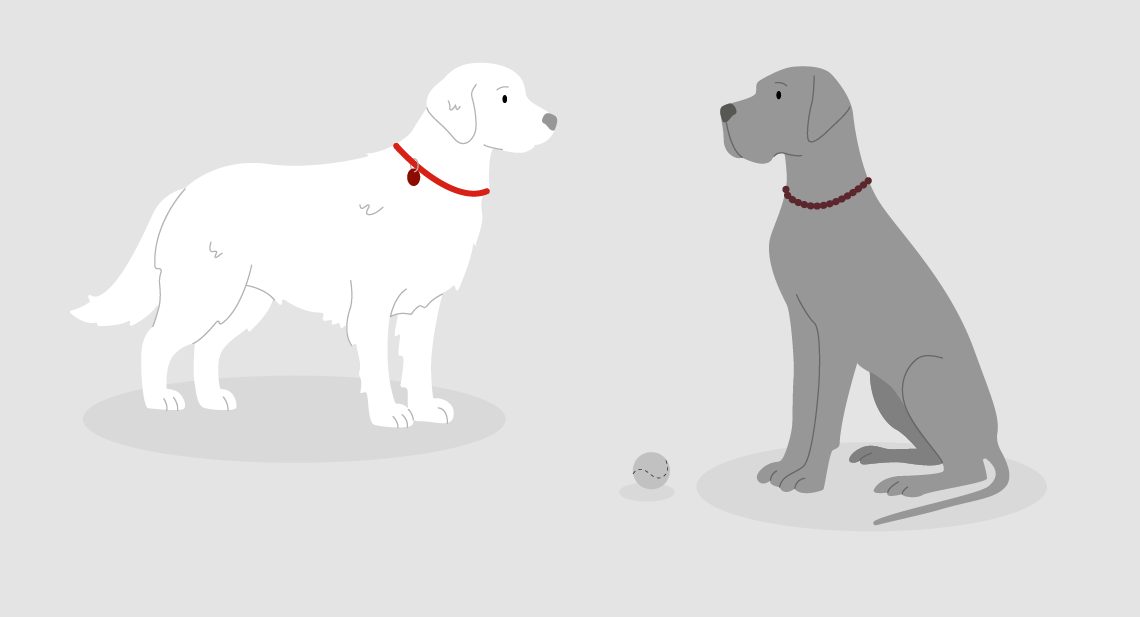
Large animals in the cargo hold
If there is no space in the passenger cabin, cats and dogs may be carried in the cargo hold if required, subject to compliance with the applicable conditions of carriage. Please provide us with the size and weight of the pet-friendly, IATA-compliant carrying container when making your booking. Please ensure that your carrying container complies with the current IATA (International Air Transport Association) regulations. This is particularly important for carrying containers purchased before 2024. We will check availability and loading options on the aircraft.
Austrian Airlines reserves the right to inspect the condition of the carrying container and your pet’s behaviour at check-in to ensure safe transport throughout the entire flight.
A maximum of two pets may be transported in a single carrying container, provided that they are accustomed to each other and each weigh no more than 14 kg.
Please note that, from 4 May 2026, carrying containers used as checked baggage (AVIH) for your pet must meet the following additional requirements to comply with the current IATA Live Animal Regulations:
- Ventilation holes must not exceed 25 mm x 25 mm for dogs and 19 mm x 19 mm for cats.
- Depending on the size of the animal, the ventilation holes must be small enough or covered with a mesh to prevent the animal from escaping or any part of its body from protruding. This helps prevent the risk of injury.
Compliant

Non-compliant
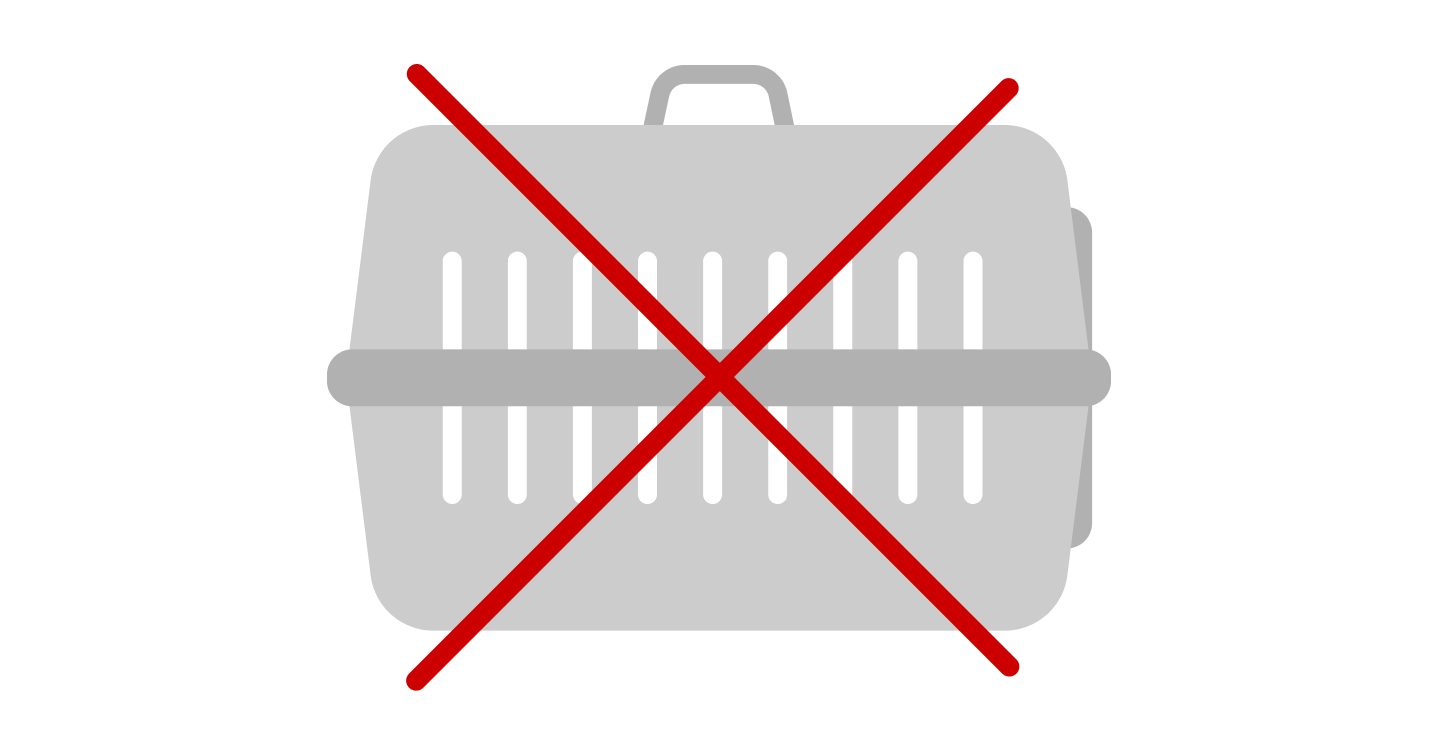
Please note that non-compliant transport boxes will be rejected at check-in, and your pet will not be accepted for transport in this case.
We therefore ask you to check your pet’s transport container well in advance and strongly recommend obtaining a compliant container before arriving at the airport. Only selected airports have shops offering pet carrying containers.*
*Please note that IATA does not certify, approve, endorse or sell any specific manufacturers, brands, models or types of pet transport containers. Passengers should be aware of fraudulent offers claiming otherwise.
Please note: in addition to the fare shown, a ticket service fee will be charged. This fee varies depending on the departure location. Additional regulations and fares may apply to flights operated by partner airlines (codeshare flights) and charter flights.
Please note that a surcharge of EUR 150 (or CHF 175 / USD 175) will be charged if you travel via Frankfurt (FRA), Munich (MUC), Vienna (VIE), Zurich (ZRH), Geneva (GVA) or Brussels (BRU). This applies to tickets issued after 1 April 2021.
- The carrying container must be suitable for the cat or dog to be carried.
- Its dimensions must allow the animal to stand, move around and lie down in a natural position.
- To ensure that the container remains intact, the inside must be smooth and must not have any protrusions that the animal could bite or scratch off.
- The top of the container must be waterproof to prevent rain, snow or hail from entering.
- For containers consisting of a top and bottom section, both parts must be securely screwed together.
- The container must be stable, lockable and clean, and must have a waterproof bottom lined with absorbent material.
- The door openings must be capable of being securely fastened.
- Carrying containers must not have wheels. If the container has wheels, they must be removed or secured so that the container can be accepted.
- Ventilation must be provided on all four sides of the container. For dogs, ventilation holes must not exceed 25 mm x 25 mm; for cats, they must not exceed 19 mm x 19 mm. These ventilation holes must either be small enough or covered with a mesh to prevent any part of the animal’s body from protruding or sticking out, thereby avoiding the risk of injury.
- The ventilation holes on the sides and at the rear must be on the top two-thirds of the container.
- Any existing spacers must be integrated into the design (both at the rear and along the length of the container). They serve as handles for the container and ensure that the ventilation holes are not blocked by other freight or bags.
- Separate bowls for water and food must be provided and securely attached to the carrying container. Water containers must not be filled for the flight, but must be accessible from outside the container. Food and water for the flight can be provided in leak-proof containers.
Special conditions apply to dogs that are classified as fighting dogs or as snub-nosed (brachycephalic) dog breeds.
Illustration of a carrying container for dogs and cats
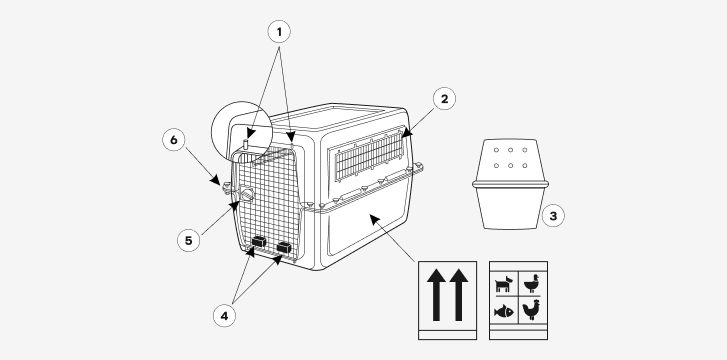
Containers made of wire or wire mesh are not permitted for air transport.
- Door hinges and latches must protrude above and below the door openings on the horizontal projections by at least 1.60 centimetres.
- Ventilation holes (dogs: maximum 25 mm x 25 mm / cats: maximum 19 mm x 19 mm)
- Rear view
- Attached food and water containers
- Door latch
- Spacers
Please note that in some countries all animals must be carried as freight irrespective of their size.
You will find more information about the carriage of unaccompanied animalsThe link will be opened in a new browser tab on the Lufthansa Cargo website.
You will find more information about the carriage of animals that are too large or too heavyThe link will be opened in a new browser tab on the Lufthansa Cargo website.
Checklist
To make your preparations easier, we have prepared a checklist with all the important points.
Assistance dogs
General requirements for taking an assistance dog into the cabin with you
To ensure the safe and undisturbed operation of the flight, your dog must be trained to obey your commands and must behave appropriately in a public space (in other words, it must not bark, growl or jump up at people).
If your dog does not behave in an appropriate manner, Austrian Airlines may transfer the dog to the cargo hold for a surcharge or refuse to carry the animal. You are liable for any damage and additional costs arising from the carriage of your dog.
Certain requirements must be fulfilled in order for you to take your dog with you into the cabin. We have summarised the most important information for you:
Registration of recognised assistance dogs on flights outside the USA
We will carry one (1) assistance dog free of charge.
- A dog, irrespective of type or breed,
- that has been specifically trained to perform tasks for a person with a disability
- (these include visual, sensory, psychiatric, intellectual or other cognitive disabilities).
You are responsible for complying with all applicable import and export regulations, as well as animal welfare requirements for your pet throughout the entire flight.
Please send us the training certificate for your assistance dog.
The training certificate should be issued by a training organisation accredited by one of the following organisations:
- Messerli Research Institute;
- Assistance Dogs International (ADI);
- Assistance Dogs Europe (ADEu); or
- International Guide Dog Federation (IGDF).
Otherwise,
please provide a certificate issued by a training organisation or dog trainer (i.e. a person specialising in assistance dog training), which includes:
- name and address;
- details of the type and duration of training; and
- the specific task the dog has been trained to perform and has successfully completed.
Please note that a certificate of completed obedience training or a DOT Form is not sufficient for travel outside the USA. Self-training and online training websites are not accepted.
If you are unable to provide this documentation, your dog will be carried under the standard pet transport conditions, either in the passenger cabin or in the cargo hold, depending on its size and weight, and subject to a surcharge.
You can find further information under 'Small pets in the cabin’ and 'Large animals in the cargo hold'.
Please also indicate the breed, weight and age of the animal.
Your assistance dog:
- must fit in the footwell in front of your seat and be secured to your seat belt with a lead provided by Austrian Airlines;
- must remain under your direct control throughout the entire flight;
- must not sit on a passenger seat; and
- must be at least four months old.
You must bring a muzzle for the dog with you. You will be asked to muzzle your dog if a situation arises where your dog poses a risk to other passengers. Otherwise, you will not be permitted to take your dog on Austrian Airlines flights. You are not obliged to carry a muzzle on flights to and from Canada. However, we strongly recommend bringing a muzzle with you nevertheless.
Registration of recognised assistance dogs on direct flights to/from the USA
We will carry two (2) assistance dogs free of charge.
- A dog, irrespective of type or breed,
- that has been specifically trained to perform tasks for a person with a disability
- (these include visual, sensory, psychiatric, intellectual or other cognitive disabilities).
- Emotional support dogs and assistance dogs in training do not qualify as assistance dogs.
Important note: from 1 March 2021, Austrian Airlines will only accept trained assistance dogs in the cabin.
Emotional support dogs and assistance dogs in training do not qualify as assistance dogs. These dogs are carried under the standard pet transport conditions, either in the passenger cabin or in the cargo hold, depending on their size and weight, and subject to a surcharge. You can find further information under 'Small pets in the cabin' and 'Large animals in the cargo hold’.
You are responsible for complying with all applicable import and export regulations, as well as animal welfare requirements for your pet throughout the entire flight.
Important note: dogs must be at least six months old to enter the USA.
If you are travelling with an assistance dog, you must complete the following forms and submit them to our Special Cases Desk as a condition of carriage. You must do this on the day of ticket purchase or afterwards.
Note:
- If you are travelling with an assistance dog and have made a reservation more than 48 hours before the first scheduled departure time of your itinerary, you must submit these forms electronically or in paper format at least 48 hours before your departure.
- If you are travelling with an assistance dog and have made a reservation less than 48 hours before the first scheduled departure time of your itinerary, you must submit these forms at the departure gate on the day of your flight.

With this form, you are confirming the health, training and behaviour of the animal.

This form is required for flights of eight hours or more.
Here, you confirm that your animal will not need to relieve itself during the flight, or that it will do so in a way that does not create a health or hygiene risk.
Please also keep this form with you during your flight.
If you have booked a connecting flight for yourself and your assistance dog, you must provide proof of training for your dog.
Knowingly and intentionally providing false, fictitious or fraudulent information on the 'Service Animal Air Transportation Form' or 'Service Animal Relief Attestation Form' in order to obtain disability-related privileges provided for under U.S. Department of Transportation regulations is a criminal offence.
Your assistance dog:
- must fit in the footwell in front of your seat and be secured to your seat belt with a lead provided by Austrian Airlines;
- must remain under your direct control throughout the entire flight;
- must not sit on a passenger seat; and
- must be at least six months old.
We strongly recommend that you also bring a muzzle for added safety and out of consideration for other passengers. You will be asked to muzzle your dog if a situation arises where your dog poses a risk to the safety of other passengers. Otherwise, you will not be permitted to take your dog on Austrian Airlines flights.
Austrian Airlines may verify whether an animal qualifies as an assistance dog under U.S. Department of Transportation regulations. To determine if an animal is an assistance dog, our staff may (1) observe the animal to check if it exhibits any disturbed or aggressive behaviour that suggests it has not been successfully trained to behave appropriately in a public environment or (2) check certain physical indicators.
Assistance dog size
Assistance dogs must fit in the footwell at the passenger’s seat, unless this would conflict with U.S. Federal Aviation Administration (FAA) safety requirements, German/European law, or restrict the space of another passenger.
Use of a lead
Austrian Airlines requires that all assistance dogs on board and in airport areas owned, leased or operated by Austrian Airlines must be kept on a lead by the assistance dog’s owner or handler (if applicable) at all times.
In accordance with the U.S. Department of Transportation regulations, Austrian Airlines may refuse to carry an assistance dog in the following circumstances:
- The assistance dog poses a direct threat to the health or safety of other persons.
- The assistance dog causes a significant disruption in the cabin or at the airport gate area, or its behaviour on board the aircraft or in the airport gate area indicates that it has not been adequately trained to behave appropriately in public areas.
- Carriage of the assistance dog would violate applicable safety or health regulations of a U.S. federal agency or territory, or a foreign government.
- A disabled passenger who wishes to travel with an assistance dog in the cabin fails to submit the completed, up-to-date forms required by Austrian Airlines.
Damage
In accordance with U.S. Department of Transportation requirements, Austrian Airlines reserves the right to hold passengers travelling with an assistance dog liable for any damage caused by the assistance dog.
Emotional support animals
As of 1 March 2021, Austrian Airlines only accepts fully trained assistance dogs in the cabin.
Emotional support dogs are no longer be classified as assistance dogs, and new bookings will no longer be accepted after this date. These dogs are carried under the standard pet transport conditions, either in the passenger cabin or in the cargo hold, depending on their size and weight, and subject to a surcharge. More information can be found below:
Snub-nosed/brachycephalic breeds
Cats and dogs belonging to snub-nosed breeds have narrowed airways due to their anatomy and may suffer from shortness of breath. The stress caused by carriage or high temperatures at the departure, transfer or destination airport may lead to circulatory problems and increased shortness of breath. Your pet could suffer serious health damage or even die during the flight. These breeds are therefore not permitted to be carried in the cargo hold.
- Affenpinschers
- American Bully (see dogs classified as fighting dogs)
- Bulldogs (all breeds with the exception of the American Bulldog)
- Bull Terriers (except Miniature Bull Terrier)
- Pugs (all breeds)
- American Pit Bull Terriers
- American Staffordshire Terriers
- Boston Terriers
- Boxers
- Brussels Griffons
- Bullmastiffs
- Bull Terriers
- Chow Chows
- English Toy Spaniel
- Japanese Chins
- Japanese Spaniels
- King Charles Spaniel
- Lhasa Apso
- Pekinese
- Pitbulls
- Shar Pei
- Shih Tzus
- Staffordshire Bull Terriers
- Tibetan Spaniel
These restrictions also apply to cross-breeds of the listed breeds.
- British Shorthair
- Exotic Shorthair
- Himalayan cats
- Persian cats
- Scottish Fold cats
These restrictions also apply to cross-breeds of the listed breeds.
Dogs classified as fighting dogs
Special conditions apply for the transport of dogs classified as having increased risk potential (fighting dogs) or as snub-nosed/brachycephalic dog breeds.
All animals classified as fighting dogs may only be transported in the cargo hold and must be placed in special transport containers.
An exception applies to dogs classified as fighting dogs that are between three and six months old. These dogs can be transported in standard transport containers. Whether a dog may be carried in the cabin or in the cargo hold depends on the basic criteria that apply to the carriage of dogs.
Please also note the additional information on transporting fighting dogs in the cargo hold.
Please also note the additional information on transporting pets in the cabin regarding dogs classified as fighting dogs that are between three and six months old.
- American Bully (generally prohibited due to possible snub-nosed features)
- American Bulldogs
- Dogo Argentino
- Karabash (Kangal) (Anatolian Shepherd Dog)
- Caucasian Ovcharka (Caucasian Shepherd Dog)
- Rottweilers
These restrictions also apply to cross-breeds of the listed breeds.
Please note: American Pit Bull Terrier, American Staffordshire Terrier, Staffordshire Bull Terrier and Bull Terrier are snub-nosed breeds and are therefore not accepted for carriage in the cargo hold.
Special carrying containers, which must comply with IATA regulations, are required for fighting dog breeds.
- The frame must be constructed from wooden or steel beams measuring at least 25 x 25 mm.
- The transport container must be made of solid wood (minimum 12 mm thick) and must be assembled using screws or bolts.
- If the door is fully ventilated with welded wire mesh (2.5 mm thick), an additional layer must be installed.
- Ventilation holes must be covered with welded wire mesh.
- Door stops must be installed to prevent the door from being pulled into or pushed out of the carrying container.
- A locking mechanism must be installed and secured with a cable/cable tie. The mechanism must prevent the transport container from being opened accidentally.
- Handles must be fitted on both long sides of the carrying container.
- The container openings must be small enough to prevent the animal from pushing any part of its body through, and the container must ensure protection against bites or scratches from the animal.
Please note: The top of the container must not be covered with mesh. However, ventilation holes are allowed in the lid.
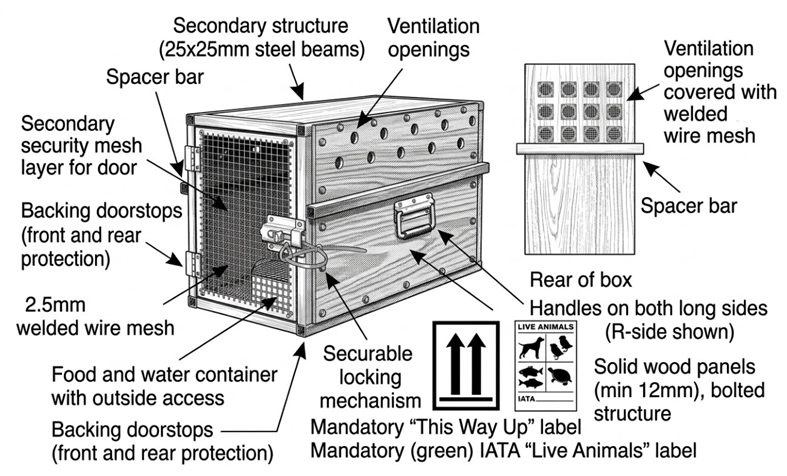
- Sliding panel with two ventilation holes, each with a diameter of 10 cm
- Entry/exit door
- Meshed ventilation holes
- Spacers with handles
- Mandatory markings: 'This way up: IATA Live Animals'
- Forklift access points
- Food and water containers with access from outside
- Drainage tray
- Welded grille
Compliance with animal welfare regulations, as well as import and export regulations
Please check the import and export regulations applicable to your pet in your departure, transit and destination countries well in advance of booking your flight, for example with the relevant embassy.
We also reserve the right to apply stricter regulations and, if necessary, refuse reservations on certain routes (e.g. to the United Kingdom) and exclude the animal from transport.
Please also ask your vet about the relevant animal welfare regulations. Obtain all the travel documentation required for your pet so that nothing will stand in the way of your trip.
Tips for the wellbeing of your four-legged friend
Flying is not only stressful for us humans. We have put together tips to help you prepare your pet for the flight and make it as comfortable as possible:
- Get your pet used to the carrying container at home as much as possible by placing the pet in the closed carrying container for a few hours several times and then rewarding it afterwards.
- Many pets are very nervous before and during the flight. Consult your veterinarian if you are considering giving your pet medication to calm it down. Pets may react unpredictably to medication and develop circulatory problems.
- Place a blanket with a familiar smell and your pet’s favourite toy in the carrying container to help keep your pet calm.
Ask your veterinarian how to adjust your pet’s feeding routine for the flight.
The regulations for dogs entering the USA changed on 1 August 2024.
Based on the new requirements of the U.S. health authorities, the Centers for Disease Control and Prevention (CDC), new bookings for dogs entering the USA are currently only possible to Atlanta, Los Angeles, Miami, New York (JFK), Philadelphia and Washington DC.
Transporting dogs to Newark (EWR) is possible provided that your dog has not been in a high-risk area (rabies) in the last six months before entering the USA.
It is still possible to carry animals as air freight to other destinations. Please contact a specialised pet transport provider for this service.
Please make sure you familiarise yourself with the new requirements in good time.
To prepare for your dog’s journey, you must complete the relevant online forms, including the 'CDC Dog Import Form' provided by the U.S. authorities. Once you have submitted the form, we will send a confirmation to the email address provided. You must present this confirmation in digital or printed form on the day of departure and upon entry to the USA.
We regret to inform you that you will be denied carriage if you do not comply with the CDC requirements.
Thank you for your understanding.
Please note:
Due to the risk of rabies, restrictions apply to the import of dogs into the USA. You can find more information about these CDC restrictions and possible exemptions on the United States Centers for Disease Control website.
Dogs must be at least six months old to enter the USA.
Assistance dogs
Assistance dogs can still be transported provided that the new CDC requirements are met and all applicable conditions are fulfilled. You will find complete information about these requirements on the CDC website. Passengers are responsible for ensuring that all requirements are met. Import/carriage will be refused if the documents required by the CDC are not presented at check-in.
Passengers who already have a confirmed booking for themselves and their assistance dog are requested to contact our Service Centre.
Separate documents are required for importing dogs into Canada as pets or trained assistance animals, including when re-entering the country, in order to meet Canadian entry requirements. If you are unable to provide these documents, there may be delays upon entry and your animal may not be permitted entry to Canada. Please find out in good time which documents you need before travelling to Canada with your animal or importing an animal into Canada.
Frequently Asked Questions
Please refer to the official Brexit informationThe link will be opened in a new browser tab.
All the regulations given here apply solely to flights operated by Austrian. For codeshare flights, please make sure to check the regulations of the airline operating the flight. If you are travelling with more than one airline, please check that your pet is accepted by all airlines involved.
You are also welcome to take your four-legged friends with you into our lounges. However, please understand that your cats or dogs should not be allowed to wander freely around Austrian Airlines lounges out of consideration for our other guests and should await their onward journey in their carrying container. Assistance dogs are exempt from this rule.
1 We will deal with your concern as quickly as possible.
The data you provide will be used solely to process your enquiry. Your data will not be shared with third parties unless Austrian is obliged to do so for legal reasons.
Email communication with Lufthansa Group airlines is not encrypted. Please bear this in mind, especially when submitting personal data such as your name, contact details or travel information. In particular, do not include such information in the subject line.